


I’ve been putting out a lot of strategy lately. Frameworks. Indexes. Operating systems. So this week, something lighter: an old internet story I remember us watching unfold in the office, back when Facebook likes still seemed like a reasonable foundation for a marketing campaign.
In 2012, Walmart and Energy Sheets announced a simple promotion: Pitbull would visit whichever local Walmart collected the most new likes on Facebook.
Fans were supposed to compete to bring Mr. Worldwide to their town.
The internet had a different idea.
It decided to send him to Kodiak, Alaska.
Not because Kodiak had the most Pitbull fans. Because it was one of the most remote Walmart stores anyone could find.
The campaign asked the audience to choose a destination. The audience chose a joke.
And then Pitbull did something unusual.
He went.
A very ordinary promotion
Strip the story back, and the original mechanism is about as unremarkable as marketing gets. “Like” a local Walmart’s Facebook page. The store that gains the most new likes wins a visit from a global pop star. It’s the kind of engagement play that launched, and quietly died, a thousand times over that decade: give us a cheap action, we’ll dangle a prize, everyone competes politely, someone wins, nobody remembers.
The ordinariness is the setup for the joke. The more forgettable the brief, the funnier it is when the crowd hijacks it. Nobody remembers the campaigns that worked as designed. This one is remembered precisely because it didn’t.
The internet accepts the rules and rejects the assignment
Enter David Thorpe, then writing for the Boston Phoenix, who went looking for the single most remote Walmart he could find, landed on Kodiak, Alaska, and pointed the internet at it under a hashtag: #ExilePitbull.
The goal was not to bring Mr. Worldwide somewhere he’d be adored. The goal was to send him somewhere very … worldwide.
And the number started to climb. Past a few thousand. Past the point where any of it could plausibly be the work of Kodiak’s actual residents. It finished north of 70,000 likes, for a town of roughly 6,000 people. More than eleven times the population had voted to exile a rapper to their local Walmart.
The crowd didn’t cheat. It didn’t stuff ballots through a security hole or counterfeit anything. It used the mechanism exactly as designed and supplied its own reason for pulling the lever.
The contest gave people an action. The hijack gave them a purpose.
That’s the moment the participation became interesting. Not when Walmart posted the rules, but when the internet decided the rules could be pointed at something better than the thing they were built for.
Mr. Worldwide makes a decision
At this point, there’s a well-worn playbook, and every brand in the world knows it. Disqualify Kodiak on a technicality. Declare that “spirit of the contest” language nobody reads until they need it. Find a reason the result doesn’t count.
There’s a name for this move now — the Boaty McBoatface treatment. Let the public vote, watch them pick the joke, then let the adults quietly win. Pitbull did the opposite.
Pitbull could have treated the whole thing as mockery. To be fair, it was. He was the punchline. The joke was aimed squarely at him.
Instead, he said:
“I will go anywhere in the world for my fans.”
He confirmed he’d go. Then he did the thing that turned a viral gag into a genuinely good story: he invited David Thorpe, the man who started the joke at his expense, to come along. When the promotional companies initially seemed unwilling to cover Thorpe’s travel, Pitbull’s own team paid for it. His manager’s explanation is still the best line in the whole affair: you don’t invite someone to dinner and then make them pay.
The crowd had cast Pitbull as the object of the joke. Two decisions - to go and to bring along the joke’s instigator - made Pitbull its co-author instead.
Exile becomes arrival
On July 30, 2012, Pitbull landed in Kodiak.
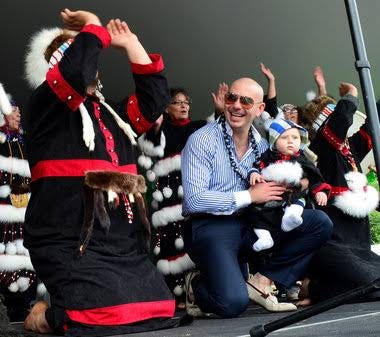
He visited the Walmart. He attended a community event at the Coast Guard base. The mayor handed him a key to the city. He left with a survival kit that reportedly included bear repellent, which is either the most or least practical parting gift a pop star has ever received. A few hours later, he was gone, back on tour.
And somewhere in those few hours, the word “exile” quietly changed meaning. It had started as a hostile joke: banish him, strand him, put him as far from relevance as the map allows. By the time he was posing for photos and thanking the town, it had become something communal and, honestly, kind of joyful. Kodiak didn’t get a punishment. Kodiak got a party it hadn’t planned, built out of a joke it hadn’t started.
The internet tried to make the destination an insult. Pitbull showed up and made it a welcome.
The audience’s agenda
This story isn’t really about how to run a public vote. It’s about what happens when the public decides your neat little promotion is actually raw material for something more alive.
The campaign offered a simple transaction: give us a Facebook like, and your town might get Pitbull. The crowd wrote a different offer: join us in exiling a publicly pompous musician to the edge of the map, and together we’ll turn a throwaway contest into a legend. One was a marketing brief; the other was a mission with a destination, a scoreboard, an underdog city, and a joke everyone could help land.
The mechanism was the structure, but not the story. The story arrived the moment people supplied their own reason for playing. That’s the quiet tension inside every participatory campaign: you can design the levers, but you don’t get to control the meaning people attach to pulling them.
And the part that’s easy to miss? The crowd didn’t just hijack the campaign; it set a test. Every party the joke touched got a chance to be a spoilsport, and every one of them declined. Walmart could have voided Kodiak on a technicality and didn’t. The promoters could have quietly found a more camera-friendly winner and didn’t — they even paid Thorpe’s way when the sponsors balked. Pitbull could have treated the whole thing as an insult, because it was one, and instead said he’d go anywhere for his fans. Even David Thorpe, who built the joke specifically to strand Pitbull at the edge of the map, got on the plane and stood in the Kodiak Walmart next to the man he’d tried to exile.
The internet set out to humiliate. Instead, it left impressed. Not because the joke failed — it worked perfectly — but because the people on the receiving end met it with generosity instead of defensiveness. That’s the thing no brief can manufacture, and no budget can buy: the crowd’s respect, earned by being a good sport about being the punchline.
The crowd authored the campaign. Everyone else authored the ending. That’s the whole trick of participation. You can hand people the levers, but the story only turns out well if, when they pull them somewhere you never planned, you’re gracious enough to follow them there.
And you’re still willing to show up when the answer is a trip to Kodiak, Alaska.