


Before there were brands, there were ceremonies.
Before markets, before media, before any of the infrastructure we’ve built to connect people to things and things to meaning, humans gathered. Around fire. Around food. Around the dead and the newborn and the changing of seasons. They marked transitions with shared acts. They turned strangers into kin through repetition and presence. They brewed fermented drinks and passed them between hands and in doing so said something that had no words yet: we are here, together, and this moment is worth marking.
Ceremony is the oldest participation technology we have. Not a metaphor, a technology. A designed system for creating shared meaning that every culture on earth, without coordination, without contact, without any common ancestor of instruction, arrived at independently. The Japanese tea ceremony and the West African kola nut ritual and the South American mate circle and the Germanic beer hall and the Mexican ofrenda — none of these borrowed from each other. All of them solved the same problem the same way. When you need people to feel that they belong to something larger than themselves, you design a ritual, and you invite them in.
This is not a historical observation. It is a description of what humans are still doing, right now, whether we call it that or not.
Every tailgate is a ceremony. Every Thanksgiving table is a ceremony. Every bar where the same group of friends occupies the same corner every Thursday is a ceremony. The form changes, the function doesn’t. We are wired, at the level of neurochemistry, for the rituals that make participation visible. We release oxytocin, the hormone of belonging, when we are in the presence of shared acts. Our mirror neurons fire when we watch others move in rhythm and pull us toward joining. The drive to gather and mark and celebrate is not a cultural habit. It is a biological instruction.
I’ve been writing about participation as the original human operating system for nearly three years now. The argument I keep returning to is that the most durable brands aren’t the ones with the largest audiences. They’re the ones that have earned the largest groups of active participants. The ones that figured out how to make showing up feel like it means something.
What I haven’t said clearly enough is that this isn’t a new insight brands need to discover. It’s an ancient truth they need to remember.
And then, a year ago, two of my co-founders at The Many decided to make a beer.
Not a craft beer. Not a flavored beer. Something more specific than that. Jens Stoelken — who grew up in Germany where beer is heritage before it is beverage — traveled to Kyoto and encountered a matcha beer at a small brewery and recognized something that most people would have dismissed as a novelty. He saw a signal. The botanical wasn’t a gimmick. It was a cultural ingredient carrying centuries of ritual in its DNA. Matcha comes from the tea ceremony. It was never just a flavor. It was the medium of a gathering practice.
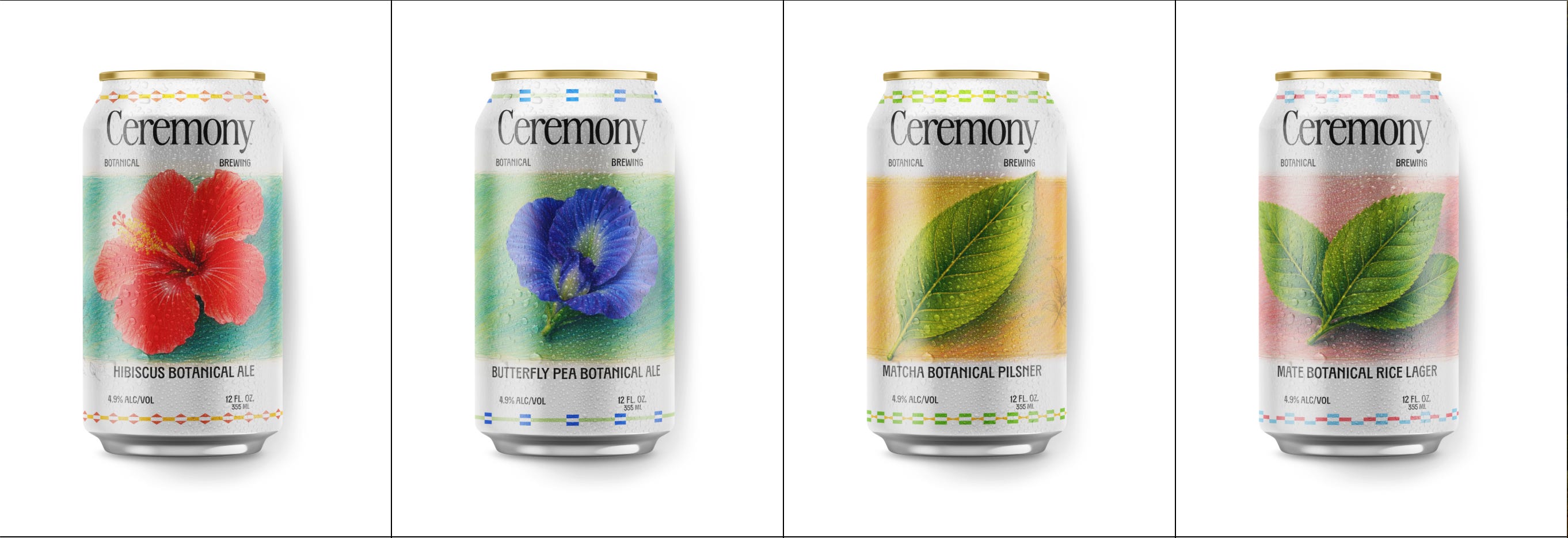
He came home and built Ceremony Botanical Brewing around that instinct, together with Blake Marquis, who named the brand and designed every element of its visual identity and packaging. The name Ceremony wasn’t a marketing decision. It was a recognition of what the thing actually was. The botanicals Jens chose are not trendy ingredients. They are ingredients that cultures selected, over hundreds of years, because they belonged to occasions. Hibiscus moves across three continents under three names — aguas frescas, bissap, karkade — and everywhere it appears, it appears at gatherings. Mate is passed in a gourd between people. That is the entire ritual. Receiving from someone else’s hands and passing it forward.
Every botanical was chosen by a culture, across time, to mark the moments that matter.
And then Jens put them in beer. Which is itself among the oldest ceremonial creations humans have made. The Sumerians wrote hymns to Ninkasi, the goddess of brewing. Egyptians placed beer in tombs as an offering. Germanic tribes sealed bonds by passing it at communal tables. The first beers weren’t made to quench thirst. They were made because humans needed a reason to gather and something to share when they did.
Ceremony inside ceremony. Ritual all the way down.
I want to say one more thing about why this matters right now, in this particular moment.
We are entering an era in which the question of what is human and what is synthetic is going to define our culture. What a person made versus what a machine generated. What it means to actually be in a room together. What counts as a real experience and what is a produced simulation. These questions are already in the air and they will only get louder. People will be looking, without always knowing that’s what they’re doing, for things that are unambiguously human. Things that cannot be machine-generated. Things that require a body, a place, other people, and the irreducible act of showing up.
A botanical chosen by a culture over centuries. Fermented by hands. Opened at an occasion. These things cannot be automated. The ritual that happens when people gather around them cannot be produced. Ceremony didn’t plan to launch a beverage that stands as a counterpoint to artificial intelligence. But it did. Because what it is, at its root, is a celebration of the thing that makes us human: the ancient, biological, universal need to gather around something meaningful and say, together, that this moment counts.
On April 4, at 4:30 in the afternoon, Ceremony Botanical Brewing is hosting a free public event at Hi Sign Brewing in East Austin, 730 Shady Lane. Live music. A local artist. The first pours of the Matcha Botanical Pilsner and the Hibiscus Botanical Ale. An open door.
If you’re in Austin, please come. Not because it’s a product launch. Because it’s an invitation. The participation is the point.
That’s always been the point.