


This is a true story that reminds me a lot of DRTV media, and is very relevant for how we might consider strategy in an ever-changing world.
In 2010, Japanese and British researchers published a study in Science with a setup so simple it borders on insulting. They took a single-celled organism called Physarum polycephalum (a slime mold, though the word undersells what it’s about to do) and placed it in a flat dish. Around the edges, they arranged oat flakes in the geographic pattern of the towns surrounding Tokyo. They put a food source at the center. Then they watched.
Twenty-six hours later, the organism had grown into a network connecting every food source that closely resembled the actual Tokyo rail system. A network human engineers had spent decades and billions of dollars designing.
I know. Stay with me.
The slime mold has no brain. No nervous system. No neurons at all. It cannot think, plan, or strategize in any meaningful sense of those words. At the cellular level it is about as simple as living things get.
It solved overnight what took us a century.

Example of slime mold in a petry dish
What It’s Actually Doing
The slime mold isn’t smart. It’s responsive.
It follows two rules with absolute consistency: grow toward nutrients, abandon paths that don’t pay off. That’s the entire algorithm. No master plan. No project manager coordinating the tendrils. Just local responsiveness applied everywhere in the network at once.
What emerges from those two rules looks, from above, like sophisticated engineering. Redundant pathways that survive single-point failures. Efficient connections that minimize distance. Fault tolerance built in not by design but by how the network grew.
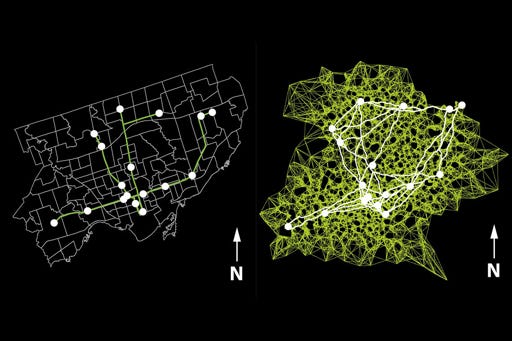
Illustration of slime mold mapping versus subway planning
The researchers weren’t only marveling. They were saying, pretty clearly, that Physarum‘s algorithm might be useful to us. That studying how it builds networks could help engineers design better infrastructure and better logistics. Their payment was oat flakes.
The Planning Problem
Every organization over a certain size eventually develops the Planning Apparatus.
Strategy decks. Quarterly reviews. Annual offsites where senior leaders gather to decide, in advance, what the organization will do and how it will do it. The assumption underlying all of it is that complex outcomes require complex coordination, and complex coordination requires someone seeing the whole picture and making deliberate choices about where resources go.
The slime mold suggests this assumption deserves scrutiny.
Planning isn’t useless. Humans aren’t slime molds, and organizations aren’t dishes of oat flakes. Real planning matters when the environment hasn’t formed yet, when regulatory ground is shifting, when the bet is capital-intensive enough that commitment has to precede feedback. But most of what the Planning Apparatus does isn’t that kind of work. It’s the ordinary work of moving an organization through an environment that is actively telling it what to do, if anyone is listening.
Reed Hastings didn’t plan Netflix’s arc from DVD-by-mail to streaming to original content to global media company. He responded, repeatedly, to what the environment was showing him. Amazon’s long-running internal principle of staying stubborn on vision and flexible on details is the same logic at different scale: keep the growth rule, abandon the paths that don’t pay off.
The slime mold would recognize this.
What Gets Built Without a Blueprint
The Tokyo rail network isn’t the only thing slime molds have designed.
Researchers have turned Physarum loose on the geographic constraints of ancient Roman road networks and found the organism builds something remarkably close to what Roman engineers did. Run the same experiment on the US interstate system or the backbone topology of the internet, and the patterns converge again. Efficient network topology has something like a right answer, and responsive systems find it whether or not they’re trying to.
This is humbling for anyone who has ever sat through a three-day strategy offsite. Which is most of us, at this point.
The network that emerges from genuine responsiveness, from paying attention to what’s working and killing what isn’t, often converges on the same place elaborate planning would have reached. Faster. With far less spent on coordination.
Thus, the slime mold doesn’t need alignment meetings because it is aligned with reality.
The Participation Connection
A cleaner illustration at human scale: Encyclopædia Britannica versus Wikipedia.
Britannica was the Planning Apparatus applied to knowledge. Expert editors. Centralized review. Quarterly updates. The structure was defensible on every conventional measure of quality control. Wikipedia was the slime mold. Millions of tendrils, each responsive only to the article in front of them, each abandoning edits that didn’t hold and reinforcing ones that did. No single tendril understood the encyclopedia it was building.
Britannica stopped printing in 2012. Wikipedia is now the default reference layer for most of the internet, including most AI systems currently being trained to replace it.
This is the participation principle at its most basic. When enough individual agents are genuinely responsive to their local environment, the system they compose develops capabilities none of them possess individually. The whole gets smarter than the sum of its parts, not because someone coordinated the parts, but because the parts were paying attention.
The brands that function this way, where employees, customers, and communities respond to each other rather than wait to be directed from a central point, develop a similar kind of intelligence. They catch cultural shifts earlier. They adapt faster. They find routes no planning process would have discovered, because no planning process had the local information to find them.
The slime mold doesn’t know what it’s building. But it builds well.
A Wild Time to Build
The Planning Apparatus was always a bit of a fiction. Right now, it’s a fiction nobody is pretending to believe.
Consider the macro variables most five-year plans depend on: interest rates, trade policy, and geopolitical alignment. All of them are volatile enough that plotting five years against them feels like a category error. AI is reshaping entire categories of work on a timeline nobody working inside it can confidently predict, including the people building the AI. Technology stacks that were stable for decades are getting rebuilt on twelve-month cycles. The environment isn’t telling us what to do next year. It’s barely telling us what to do next quarter.
This is a bad moment for the Planning Apparatus but a great moment for slime mold rules.
Grow toward nutrients. Abandon paths that don’t pay off. Run the experiment. Keep what works. Kill what doesn’t. Do it again. Stay alive long enough for the network to reveal itself.
It’s a wild time to build, and probably the best time to build in the history of humanity. Follow the slime mold’s two rules, and you’ll most likely be fine.
A great moment for slime mold rules.
The Question Worth Asking
The researchers who ran the Tokyo study weren’t arguing we should replace urban planners with petri dishes. They were asking a stranger question: what can a system with no intelligence teach us about how intelligence works?
Their answer was that intelligence, at least in applied form, might be less about thinking and more about responsiveness. Less about having the right plan and more about having the right feedback loops. Less about someone at the top seeing the whole picture and more about everyone at the local level staying honest about what the environment is telling them.
A single-celled organism with no brain outplanned Tokyo because it never stopped responding to what was actually true.
Most organizations would do well to try the same thing.
Sensibilities and Emotional Intelligence to sense flow and contexts to strive in a world with plenty of other intelligentsia.