


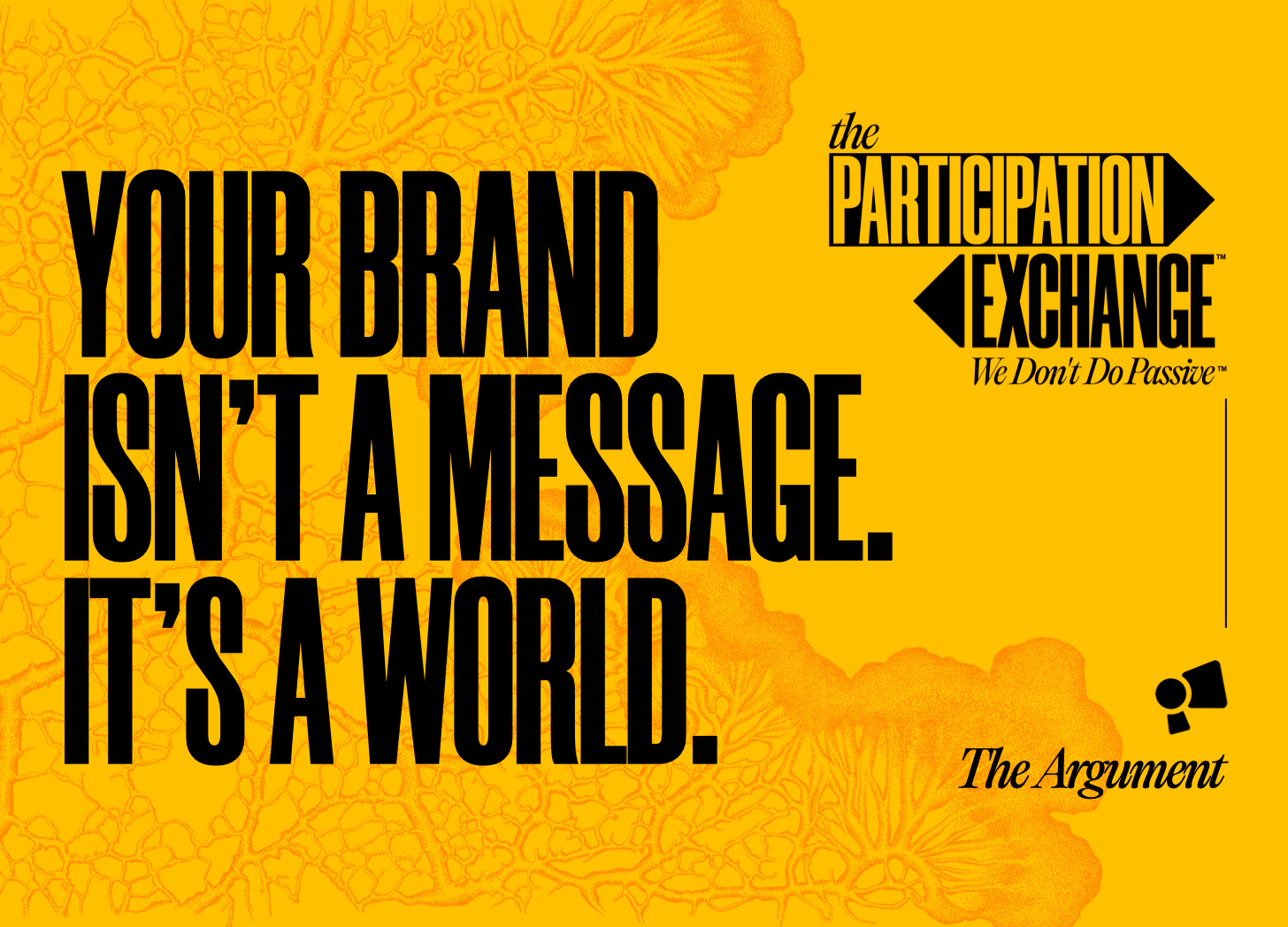
The most magnetic brands today aren’t fueled by campaigns. They’re emerging as full-blown worlds. This constitutes a fundamental shift in what brands actually do and how value gets created.
To understand this shift, start with what changes when you stop thinking in campaigns. Campaigns are finite: they have launch dates and end dates, creative assets with shelf lives, media budgets that get depleted. Worlds are continuous: they provide ongoing infrastructure where people show up, contribute, connect, and create value together. Campaigns broadcast messages outward, hoping for response. Worlds create spaces inward, inviting contribution.
Your Brand Is a World With its Own Physics.
Think of your brand as a world, not a message. Every world needs rules that make it recognizable: gravity, language, aesthetics, values. These aren’t constraints; they’re what make the world a world rather than formless space. The world has physics (values, tone, aesthetics) and rituals that make it recognizable and distinct. Your job isn’t to micromanage every detail. It’s to maintain integrity of the core physics while giving people tools to live in that world, to build their own stories within it, to make it theirs through inhabitation.
Nike doesn’t just sell shoes. It creates a context where people can understand themselves as athletes, regardless of their skill level or competitive accomplishments. The world’s physics say that movement matters, that pushing yourself counts, that your body is capable of more than you think. Within that world, a morning jogger and an Olympic marathoner are both athletes, just exploring different territories of the same landscape.
Red Bull doesn’t just sell energy drinks. It creates permission to live without boundaries, to attempt the extraordinary, to see limits as invitations rather than barriers. The world’s physics say that human potential is meant to be tested, that creativity thrives at edges, that the impossible is just the not-yet-accomplished.
These aren’t products. They’re participatory mythologies. Permission structures for identity. Contexts for meaning-making that people choose to inhabit because the worlds offer something more valuable than functional benefits … they offer ways of understanding who you are and who you might become. When you enter Nike’s world, you’re not buying footwear; you’re claiming an identity. When you enter Red Bull’s world, you’re not purchasing caffeine; you’re accepting an invitation to see yourself differently.
This is closer to how language itself works. No one controls English, yet it remains recognizable across continents, contexts, and centuries. It has grammar, patterns, norms—but infinite variation in expression. The most participatory brands operate similarly: stable in the center, adaptive at the edges.
According to research by Sarasvuo, Rindell, and Kovalchuk in the Journal of Business Research, brand co-creation happens through “intentional interaction between or among two or more parties that influences a brand.” The operative word is “intentional.” Meaning is made deliberately, through active exchange, not absorbed passively through repeated exposure. The world’s physics—those stable values and aesthetics at the center—create the conditions for that intentional interaction while the adaptive edges allow for infinite variation in how people inhabit and express the brand.
Worlds create infrastructure for this intentional interaction. They provide tools for creation, spaces for gathering, mechanisms for recognition, paths for progression from observer to contributor to co-creator. They don’t control what gets built; they enable what communities choose to build.
Inhabitants, Not Audiences
The broadcast era convinced us that brands could control their meaning by controlling their messages. Perfect the thirty-second spot, buy enough media weight, repeat the tagline often enough, and audiences would internalize what you intended.
But that was always fiction. Even at the height of Madison Avenue’s golden age, meaning was being negotiated in living rooms, debated around water coolers, reinterpreted through cultural lenses the brand never anticipated. The control was illusory. We just couldn’t see the audience’s side of the conversation.
People don’t consume brands now. They create them, share them, and fundamentally shape what they mean. This is a recognition of how meaning actually works … and always has worked, even when infrastructure made that process invisible. No matter what the ad industry told itself, audiences were never passive recipients dutifully absorbing carefully crafted messages. They were always active interpreters, meaning-makers, collaborators in constructing what brands represented in their lives. The difference now is that worlds make this collaboration explicit, intentional, and scaled.
Where campaigns treat audiences as targets to be moved through predetermined stages toward conversion, worlds recognize them as inhabitants who shape meaning through voluntary contribution. In a campaign, you’re trying to change someone’s mind or drive a purchase. In a world, you’re creating conditions where people contribute because participation itself is intrinsically rewarding. The motivation shifts from external persuasion to internal satisfaction.
And when people shape a world, they feel it’s theirs. The labor creates the love.
This isn’t just sentiment, it’s psychology. The IKEA effect shows that people value things more when they’ve participated in creating them, even when the participation is as minimal as assembling flat-pack furniture with an Allen wrench. The time spent, the choices made, the creative energy expended all become inseparable from the object itself.
Research shows that value co-creation behaviors directly strengthen customer loyalty and brand equity. Participatory engagement fuels word-of-mouth and purchase intent because people advocate more passionately for things they’ve helped build. Your community isn’t just an audience to market to. They’re a resource to learn from, a creative engine to tap into, a collective intelligence that sees opportunities your team misses. Their distributed creativity, operating across thousands of different contexts and needs, generates innovation at a scale and specificity that centralized teams simply cannot match.
The World-Builder’s Dilemma
When brands operate as worlds rather than campaigns, they immediately confront a tension that campaign-based marketing never had to face. Campaigns maintain control through their finite nature: The creative is locked, the message is approved, the media buy is scheduled, and nothing deviates from the plan. Worlds, by contrast, invite unpredictability the moment they open their infrastructure to participation.
Open your world too much? It dissolves into incoherence. A shapeless cloud of conflicting interpretations where nothing means anything anymore because everything is permitted. Control it too tightly? You suffocate the very creativity that makes participation valuable in the first place. You end up with a world that feels like a disguised campaign: the appearance of openness with the reality of constraint.
Scholars call this the “brand identity co-creation dilemma.” It’s real, and it doesn’t have an easy resolution. When brands build platforms that invite genuine participation, they gain authenticity, engagement, and advocacy that can’t be manufactured through traditional marketing. But they also risk fragmentation, dilution, and loss of coherent meaning when too many voices pull the brand in too many directions simultaneously. The platform provides the stage, but who decides what story gets told there?
The answer isn’t a formula. It’s a sensibility: build scaffolding, not walls. Give people the grammar of your brand world, then let them speak their own dialect. Learn to live with the tension, to navigate with judgment and courage, to balance through constant recalibration.
Yerba Madre learned this when their community started calling the product “Yerbs,” which is a pet name that emerged organically from people who’d made the brand theirs. The instinct to correct it, to reassert the “proper” name, would have been the campaign-era response. Instead, they embraced it as evidence that people weren’t just drinking a beverage; they were inhabiting a world. A world already rich with its own language, and a lexicon rooted in the plant’s sacred origins that gave people the grammar to build upon. “Yerbs” wasn’t dilution it was actually dialect.
The tension between structure and freedom never fully resolves, and that’s precisely the point. Brands that thrive as worlds don’t eliminate this tension, they learn to navigate it with increasing sophistication, developing institutional muscle memory for when to hold firm and when to flex.
What World-Building Requires
If “brand” used to mean logo and tagline, today it means infrastructure for expression. You’re building a context where people show up with ideas, knowing both what’s possible and what makes it recognizably yours. The scaffolding isn’t abstract; it’s built from specific, intentional elements that create the grammar people need to participate meaningfully.
A clear scaffold. This is your stable center. The core grammar that makes your world recognizable and distinct. You need a world identifiable enough that people know when they’re inside it. Without this clarity, your world becomes formless. All edges, no center.
User-driven creation. Scaffolding only matters if people can actually build upon it. Threadless lets users design the products that get manufactured and sold. Spotify gives users tools to become curators themselves, with the most successful user-generated playlists attracting millions of followers. This requires trusting your community to have taste and valuable perspectives.
Connection and community. People don’t connect with points. They connect with each other. Peloton’s world succeeds not because of the bike but because riders form teams and develop genuine friendships through shared struggle. When you build infrastructure for people to connect with each other rather than just transact with you, you transform customers into community members.
Curation loops. Participation needs to be visible to be meaningful—both to the contributor who wants recognition and to the observer who’s deciding whether to contribute next. GoPro curates and celebrates user-generated footage, turning customers into filmmakers whose best shots get featured in brand channels.
Layered access. Not everyone wants to participate at the same intensity, and your world needs to honor that reality. Different levels of involvement for different levels of interest. Not everyone wants to be a creator. Some want to curate. Some want to comment. Some want to witness. Red Bull’s Flugtag exemplifies this: teams invest months building flying machines, spectators attend live events, millions watch content online, and countless others share clips on social media. Each layer is valuable, and each layer feeds the others.
When these elements align, they create the conditions where the tension between openness and coherence becomes productive: the world has enough structure to remain recognizable, enough freedom to enable genuine creativity, and enough infrastructure to turn individual participation into collective momentum.
The Bottom Line
Consistency once meant control. Now it means coherence amid variation.
The most powerful brands will invite participation without losing themselves, turning audiences into collaborators, fans into storytellers, consumption into creation.
Because when people see themselves as belonging inside a brand’s world, they don’t just buy the product. They live the brand. They defend it. They contribute to it. They make it theirs.
The future of brands is participatory because the future of meaning is participatory. Meaning was never delivered from above. It emerges from contribution. The brands that understand this will build durable and alluring worlds for their people to enjoy. The ones that don’t will keep renting attention until they can’t afford it anymore.
Sources
Sarasvuo, S., Rindell, A., & Kovalchuk, M. (2022). “Toward a conceptual understanding of co-creation in branding.” Journal of Business Research, 139, 543-563.
Norton, M. I., Mochon, D., & Ariely, D. (2012). “The IKEA effect: When labor leads to love.” Journal of Consumer Psychology, 22(3), 453-460.