


Logan Sudeith is 25 years old. He makes most of his trades from bed, laptop propped on his chest, in his Atlanta apartment. He estimates he spends about 100 hours a week on prediction markets.
Last month he made $100,000.
As profiled in NPR, Sudeith is not unusual. He’s just one of the more successful participants in an industry that processed more than $5 billion in volume during the last week of 2025 alone. An industry that barely existed two years ago. An industry that is rapidly becoming, in the words of Polymarket’s CEO, “the most accurate thing we have as mankind” for predicting future events.
How did this happen so fast?
The answer isn’t gambling addiction or crypto speculation. It’s participation. This emerging industry is growing because it lets ordinary people contribute to something that used to be reserved for experts: forecasting the future.
Welcome to prediction markets. Where collective intelligence and collective degeneracy turn out to be the same thing.
The Trust Vacuum
We live in an era when nobody agrees on what’s true.
Polls feel weighted. Media feel biased. Experts contradict each other on cable news. Scientific consensus gets politicized. The institutions that used to tell us what was real have exhausted their credibility, and now everything feels like narrative.
Then came the 2024 election.
Polls had it as a coin flip. Trump versus Harris, too close to call. But Polymarket had Trump as a clear favorite. Kalshi agreed. The prediction markets saw something the polls didn’t.
Trump won. The prediction markets had called it. And suddenly everyone paid attention.
What changed wasn’t just the numbers. It was the narrative. Before the election, prediction markets were curiosities. After, they were oracles. Polls have long been relied upon as barometers of public opinion, but they’ve developed a credibility problem. Too many people suspect they’re weighted to create narratives rather than reflect reality. Prediction markets were initially met with even stronger skepticism, but after that 2024 election they earned real trust. When someone puts $50,000 on an outcome, you believe they mean it.
The skin in the game isn’t just an accuracy mechanism. It’s a credibility mechanism. When you can’t trust the source, you trust the incentive. And suddenly, participation became more credible than expertise.
Participation Markets
What prediction markets actually are: participation infrastructure.
Before Polymarket and Kalshi, if you had strong opinions about geopolitics or economics or scientific outcomes, you had two options. You could yell into the void on social media or you could become a professional analyst. There was no way for an ordinary person to contribute their knowledge to a collective forecast. No way to participate in predicting the future.
Now there is.
Today, if you want to bet on an election, Kalshi is the legal option for Americans. It’s a CFTC-regulated exchange where you can wager real dollars. Polymarket is the larger platform by volume but operates offshore, accessible mainly through crypto wallets. Between them, they’ve opened forecasting to anyone willing to put money on their convictions.
The result is collective intelligence at scale. Thousands of people researching, analyzing, and betting on outcomes. Each trade is a contribution. Each position is a signal. The aggregate is smarter than any individual participant, more objective than most expert panels, and updating in real time.
This is participation doing what participation always does: creating something communal that exceeds individual capacity.
Everything Gets a Price
Here’s what the front page of Kalshi looks like right now.
Will the Federal Reserve cut rates in March? Will MrBeast’s next video get 70-80 million views in its first week? Will the U.S. invade Greenland this year? Will Elon Musk tweet more than 580 times this week? Will we confirm alien life?
The 2025 Golden Globes announced Polymarket odds before every commercial break. The NHL’s New York Rangers signed Polymarket as their official prediction market partner. The Wall Street Journal’s parent company is partnering with Polymarket. South Park did an entire episode about it. Truth Social is launching Truth Predict, its own prediction market platform.
The CEO of Kalshi has stated that his long-term vision is “to financialize everything.”
Some of this is absurd in the best way: humans collectively pricing uncertainty about questions we couldn’t even ask a decade ago. When will we confirm extraterrestrial life? What will the Fed do next? Some of it is deeply uncomfortable: bets on mass starvation in Gaza, on whether an ICE agent will be charged after a fatal shooting, on nuclear war with Iran.
That’s what unconstrained participation looks like. The market doesn’t discriminate between the delightful and the disturbing. That’s the feature that makes it work.
The Texture of Participation
The traders are young, mostly male, and very online. They have strong opinions about probability. They spend their days researching arcane questions, looking for edges, placing bets from their laptops. They speak in a specific argot. They form communities on Discord and Twitter. They share tips and strategies and wins and losses.
That sounds like community. And maybe it is. Or maybe it’s just shared obsession with the same game.
Prediction markets are participation without gift exchange. Connection without warmth. Intelligence without belonging.
The distinction matters for anyone building participatory systems. Prediction markets are participation without gift exchange. Connection without warmth. Intelligence without belonging. It’s a different texture than the community-building version of participation. But it still works. It still creates something larger than any individual could produce alone.
That’s worth noticing. Participation doesn’t require community to generate value. Competition works too. Skin in the game works too. The mechanism is more flexible than the warm version of the story suggests.
The Signal
For anyone watching participation reshape industries, prediction markets are a proof of concept.
Two years ago, this industry barely existed. Now it processes billions in volume. The growth curve is almost vertical. And it happened because someone built infrastructure that let ordinary people participate in something they previously had no access to, whether out of genuine curiosity, the thrill of the game, or the prospect of making real money.
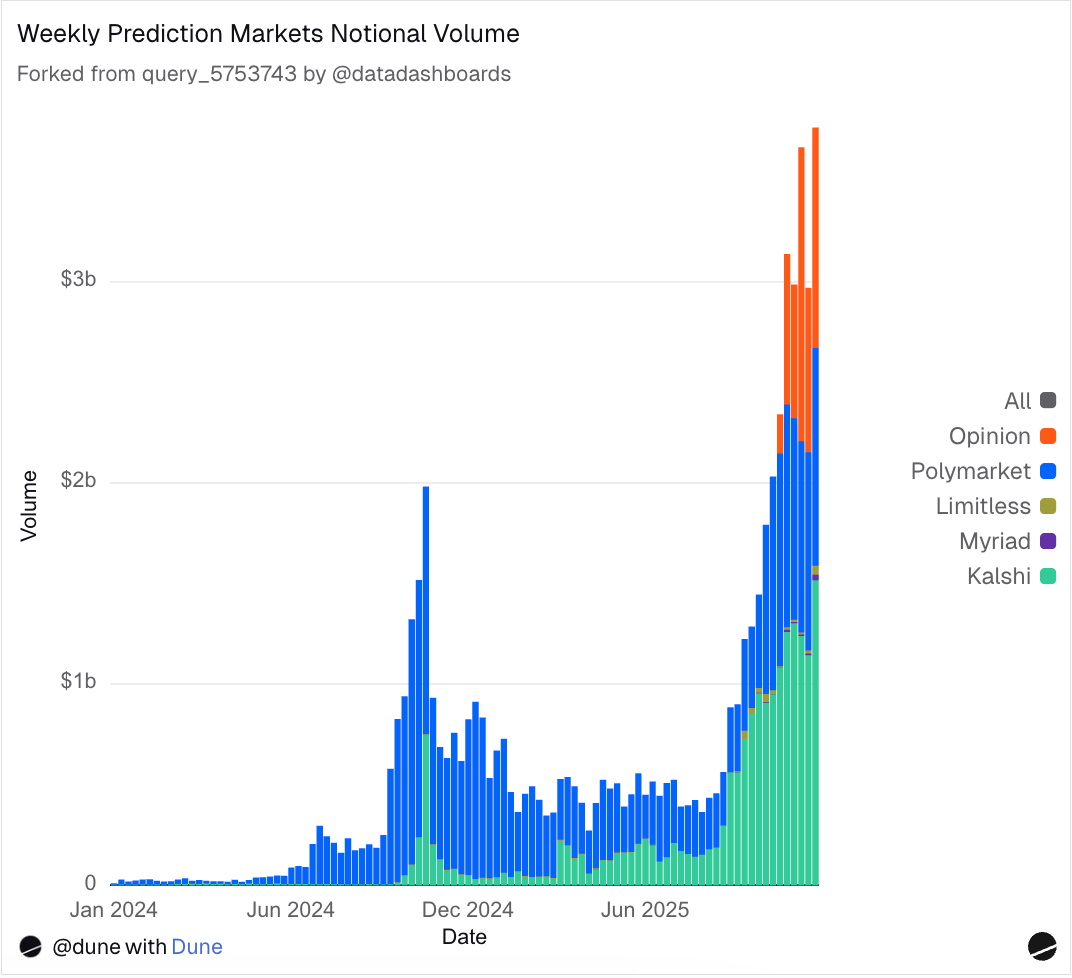
Prediction market volume didn't spike for the 2024 election and fade. It came back bigger. Source: Dune/@datadashboards
The trust vacuum helped. When institutions lose credibility, participatory mechanisms fill the void. But the deeper driver is simpler: people want to be active. They want agency. They want to be part of something larger than themselves, even if that something is a zero-sum betting market.
Prediction markets are participation markets. That’s the insight underneath all the noise about accuracy and gambling and financialization.
The participation is real. The intelligence is real. The growth is real.
The moral cost is also real. Every platform that invites participation must answer for what it unleashes.
So is it collective intelligence or collective degeneracy? Yes. That’s the point.