


Guillermo Rodriguez has been Jimmy Kimmel’s sidekick for more than 20 years, and before that he guarded the parking lot at Kimmel’s studio. On September 15, 2026, the first night of Season 35 of “Dancing with the Stars,” he danced a cha-cha to Jean Knight’s “Mr. Big Stuff,” with plenty of jumping and gyrating and not much that resembled a cha-cha. The judges gave him 10 out of 30, the second-lowest score in the show’s 21 years, and the ballroom booed them for it. Then the audience at home voted, and Guillermo stayed.
I should mention that I don’t watch “Dancing with the Stars.” I can still tell you Guillermo’s scores, because news of this season reached me the way it reached a lot of people: through “Jimmy Kimmel Live!” and whatever video clips and commentary turned up online the next morning.
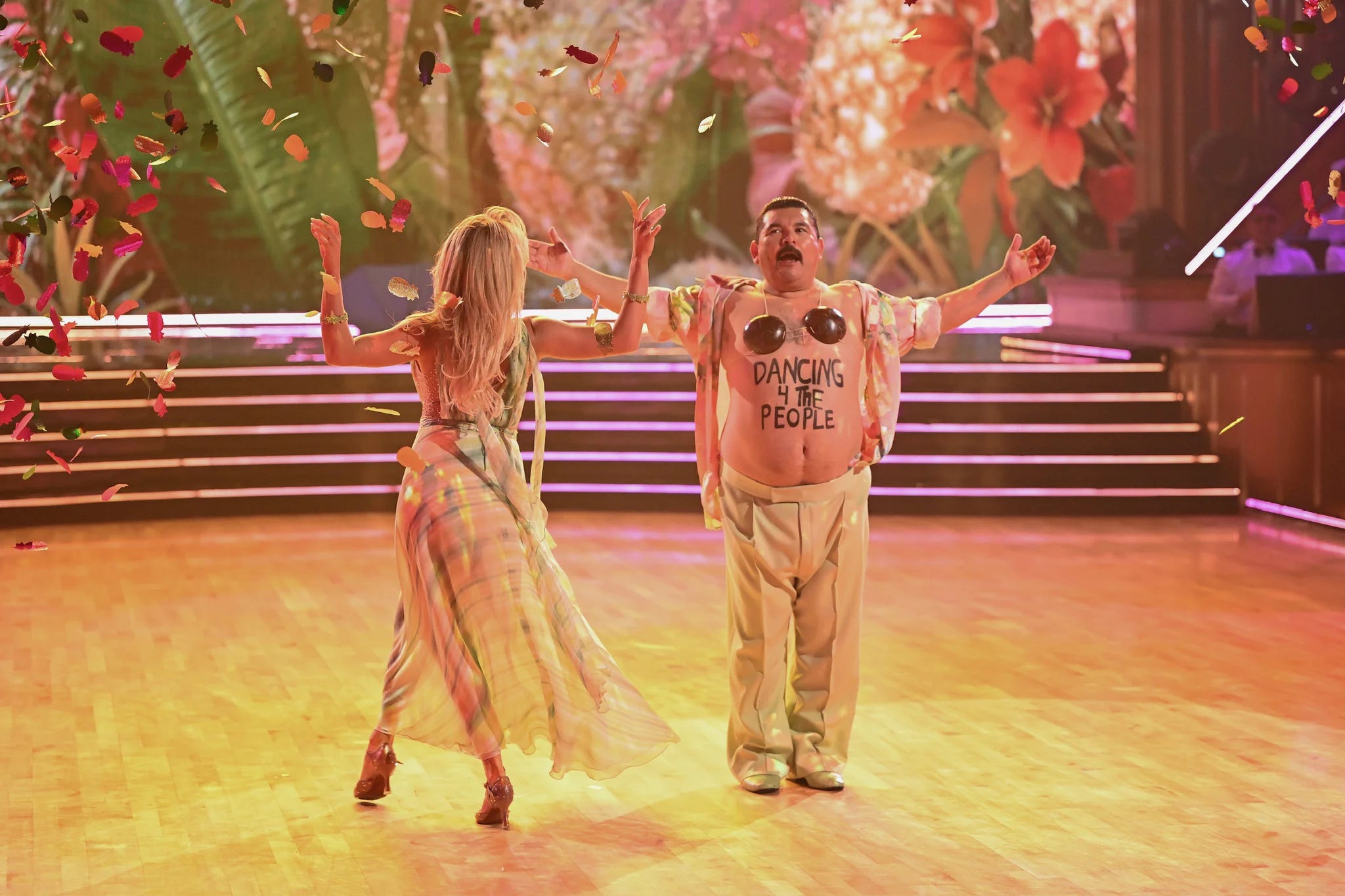
His partner was Witney Carson, the reigning champion, pregnant with her third child. Plenty of people assumed she’d been handed Guillermo as a gentle early exit. She told “Entertainment Now” she wanted to win twice in a row, and when she mentioned this to her partner he told her, “Witney, don’t be greedy.” Kimmel, reviewing the footage, offered his own analysis: “I notice your strategy seems to be to dance not with Guillermo but around Guillermo.” She got him around a lot of floor. Two troupe dancers slid him across the finish of their Week 2 paso doble. For Yacht Rock Night the following week, she worked an umbrella into a foxtrot to “Escape (The Piña Colada Song),” and he closed it by pulling open his floral shirt to show the message underneath: DANCING WITH THE PEOPLE. A week after that, he lay flat on the floor for several seconds in the middle of a samba to Mariah Carey’s “Obsessed.”
Every week he finished last or tied for last on the judges’ board, and every week a couple with an equal or better score went home instead. Kimmel campaigned for him the whole way. Taping in Brooklyn on September 28, he promised “every American in this theater a check for $5,000” if Guillermo won. When viewers called the competition rigged, he replied that “life is rigged in Guillermo’s favor.” Kimmel’s show airs on ABC, so the network had, in effect, entered its own employee and handed him a nightly megaphone. But no megaphone, however big, can make anybody care.
The rest of the internet split between viewers who adored Guillermo and viewers furious that better dancers kept leaving. After Ciara Miller went home on Mariah Carey Night, one fan on X asked if Guillermo was “the new Bobby Bones.”
The save that came and went
That fan was reaching back to 2018, when the radio host Bobby Bones won Season 27 with scores well below the rest of the finalists. The backlash was strong enough to change the rules. From Season 28 on, when the bottom two couples were revealed, the judges chose which one stayed, a power that came to be known as “the save.”
It lasted four seasons and vanished at the start of Season 32, in 2023, with almost no announcement. Executive producer Deena Katz explained the decision to TVLine in February 2024: “I think it should be about America.”
Viewers have supplied half of the combined score since the show’s first summer in 2005. ABC has never published the formula, but former pros describe two pies. Each couple gets its share of the night’s judges’ points and its share of the night’s votes, and the two are added together. The judges can only shrink your slice so far, since even a disastrous night earns a 10 against a winner’s 24. The audience can hand you most of the plate. Removing “the save” took away the one step where the experts could overrule that math, and the show has kept it away through Seasons 32 to 35.
That has a price, and Season 35 showed it. Critics pointed out that women in the cast get far less room to be charmingly bad than Guillermo did. Giada De Laurentiis went home in Week 2 with 12 out of 30, the same score Guillermo posted that night. A judges’ save wouldn’t guarantee fairness, since judges carry their own blind spots, but without one the crowd’s preferences go straight into the result, good and bad.
Voting on television goes back a long way. MTV’s Total Request Live let viewers vote the daily countdown from 1998, and American Idol made the phone vote a national event in 2002; I write about both in Wired to Participate. I’ve also written here about two later tests of the same nerve. In 2016 the British public chose Boaty McBoatface as the name for a new polar research ship, but the research council overrode them and named the ship after David Attenborough, giving Boaty to an autonomous submarine. In 2012, the internet voted to exile Pitbull to Kodiak, Alaska, and Pitbull got on the plane (The Internet Tried to Exile Pitbull. He went. Dancing with the Stars has run both experiments on itself, first the submarine and then the plane ticket.
Seventy-two million votes
The show has grown in popularity while letting stand outcomes its judges didn’t like, though the timing takes a little unpacking. “The save” went away in fall 2023, and the big jump came two years later, in Season 34. That fall ABC cast for younger viewers, with TikTok star Alix Earle, Whitney Leavitt of “The Secret Lives of Mormon Wives,” Olympic gymnast Jordan Chiles, Dylan Efron and Robert Irwin, while the pros and stars posted rehearsal clips and internet trends all week between episodes. That season had its own lovable non-dancer, too: Andy Richter, Conan O’Brien’s longtime sidekick, who lasted deep into the competition on effort and charm. Two seasons running, America’s favorite bad dancer has been a late-night sidekick.
The numbers followed. The Season 34 finale drew 9.24 million viewers, the most in nine years, and viewers cast 72 million votes, up from 32 million the year before. This season, the online voting site crashed on premiere night, and one week later a regular Tuesday episode beat last year’s finale voting record. Each viewer can cast up to 10 votes per couple online and 10 more via text, so the totals reflect enthusiasm as much as headcount. Either way, participation has grown faster than the audience.
Guillermo didn’t build that curve, and dropping “the save” didn’t either. What ABC did was let its audience’s vote stand when the results got uncomfortable, and the audience kept showing up in bigger numbers.
The second vote
Kimmel asked for votes. Nobody asked for the dance moves to go viral.
The moment this clicked for me came when Kimmel posted a run of TikToks from people copying Guillermo’s moves. Some were people dancing alone, and some were groups, a few of them clearly whole families getting in on it. A TikTok of yourself doing the Piña Colada foxtrot is a second ballot, cast with your body, and it costs a lot more than pressing a button as an episode is wrapping up.
After Yacht Rock Night, the Loco Beach Coconuts, a Banana Ball team, posted a video of their player Erik Ostberg recreating the foxtrot on the field. Jackson Olson, who plays for the Savannah Bananas and was also in this season’s cast, left a snide comment underneath. Guillermo’s fans buried him, which was the same enthusiasm with its teeth showing. Olson deleted the comment, then apologized by recruiting Guillermo into a TikTok with him. A ballclub’s parody of a dance had become a plot point in the competition where the dance had originated.
In the book, I write about memes as a creative outlet most people use every day without calling it that. A meme travels when the next person can add to it without special skill, and Guillermo’s dancing was ideal for that. Harry Shum Jr.’s jive is beyond almost everyone watching at home, while anybody with a phone and a floral shirt can take a run at the Piña Colada foxtrot. The judges score difficulty, but the people filming themselves were rewarding something closer to copyability.
The last dance
The run ended on October 13, in Week 5. The theme was Super Bowl Night, with every couple dancing to music from past halftime shows, and NFL announcer Joe Buck sat in as a fourth judge, which put the scores out of 40 for the night. Guillermo and Witney danced a salsa to Bad Bunny’s “Tití Me Preguntó” and earned 22, the best score of his season and still the lowest of the night. They landed in the bottom two and went home.
No veto was needed. The same vote that carried him through four eliminations let him go on the fifth, whether because his crowd moved on or because a bigger one outvoted it, and nobody had to rescue the show from its audience along the way.
Tuesday night
Most of the art and information that reaches people this year doesn’t respond to anything they do. Wars, politics, AI fears, and the daily news cycle keep coming regardless of what anyone thinks of them. A vote for a 55-year-old in sequins responds. You press the button, he stays, and the next morning you can see your contribution on the leaderboard.
People voted for him for their own reasons, some out of affection and some to needle the judges. For five weeks they had a small, silly piece of control over something, and shared the company of everyone else doing the same. Then a lot of them went further and danced. Guillermo’s shirt said DANCING WITH THE PEOPLE, and for once a slogan undersold the thing it described. They danced alone, in groups, in whole families, and on a Banana Ball field.
Before your next brief goes out, imagine the audience choosing your Guillermo: the person, idea, or moment your team would never have put first. Would you let that choice count? And would you recognize the opportunity when people started making their own versions of it? ABC didn’t choreograph the family TikToks or the dance on the baseball field. It let the vote stand, and people found their own reasons to keep the story moving. If you want to dance with the people, you’ve got to let them lead sometimes.