Ok everyone, I’m back. I apologize for the lack of essays over the past few weeks but the summer was hectic, The Echange has put out over 30 pieces of weekly content this year, and I needed a short break. But here we go with weekly drops through the end of the year. Enjoy.
In September 2005, the makers of the online game World of Warcraft added a new monster for players to fight. Beating it meant surviving a spell called Corrupted Blood, which drained your health quickly and was supposed to remain in that one remote corner of the game and vanish the moment the fight ended.
It didn’t stay put. A glitch let players’ in-game pets carry the infection out of the dungeon and into the crowded cities, where it jumped from one character to the next and killed weaker players in seconds. Within days, the game had a full-blown digital plague. Players scattered, some fleeing the infected cities, others staying behind to heal strangers, and a few hunting people down to spread it on purpose. The streets filled with the bones of the dead, and it ran for about a week before the studio wiped it out by resetting the servers (Wikipedia).
Thanks for reading The Participation Exchange! Subscribe for free to receive new posts and support my work.
Nobody designed that. No one wrote it or approved it. A stray line of code produced an event so lifelike that epidemiologists later studied it as a model for how real people behave in a real outbreak (Lofgren and Fefferman, Lancet Infectious Diseases, 2007). Two decades on, players still tell the story. It is one of the most memorable things that ever happened in that game, and the designers had nothing to do with it. That turns out to be the whole point, and it is the thing most brands have never learned to build.
How Games Went Multiplayer
To see why that matters for a brand, it helps to look at how games themselves changed. For most of their history, video games were single-player. A designer wrote a story, built the levels, and set the challenges. You picked up the controller, played through the experience they had authored, reached the end, and put it down. It could be brilliant, but it was a finished thing handed to you. You were the audience for someone else’s work.
Multiplayer changed what a game even is. Once other real people are in the world with you, they become the most interesting thing in it. No designer can script another human being. The other players are unpredictable; they can help you or wreck your plans, and the game stops being a story you move through and becomes a place where things happen between you and everyone else. The designer’s job flips. You stop writing the story and start building a world that is good enough for other people to make their own stories inside.
That flip adds everything a single-player game structurally can’t. No two sessions play out the same way, so the world stays alive. What you do carries weight, because other people are there to see it. You become someone inside that world, known for how you play and what you contribute. And most of all, you have agency. You are not being told a story; you are acting inside one and changing it for other people, and that is a completely different feeling from watching.
You don’t need much for this to work. In the 2012 game Journey, you are paired with a stranger in a desert. You can’t speak to them, you can’t see their name, and the only thing you can do is move and give a single wordless chirp. That is the entire toolkit, and players routinely call the companionship that results one of the most affecting experiences they’ve ever had in a game (GamesIndustry.biz). The bond doesn’t come from more features. It comes from being given a reason to need another person and almost nothing to hide behind.
Designers have spent decades learning to build for this, and one rule they repeat is to start with the feeling. “Think of the feelings that you want to bring to the players,” as the designer Robin Hunicke has put it, and then work backward to the rules that might produce it (GamesIndustry.biz).
The Best Parts Are the Ones Nobody Planned
Here is the strange part. When you build a world with a few good rules and fill it with people, they start doing things you never planned. The rules combine in ways you didn’t foresee, players invent uses for them you never intended, and the results are often better than anything the designer could have written. Game designers have a word for this. They call it emergence, and the simplest way to think about it is unintended consequences that turn out to be the best part of the game.
The World of Warcraft plague was emergence. So was one of the strangest things ever to happen online. In 2017, and again in 2022, Reddit ran an experiment called r/place: a giant blank canvas where any user could place a single colored pixel, then had to wait before placing another. That was the entire game. One pixel at a time. In the 2022 run, more than ten million people placed over 160 million pixels across three and a half days, and what emerged was not chaos. Communities formed alliances, negotiated borders, defended their territory, and built enormous shared artworks, none of it required or designed by anyone (Adweek). The rule was almost insultingly simple. The behavior was a civilization.
One pixel at a time, ten million people, and a world with its own diplomacy. That ratio, a tiny rule and an enormous emergent result, is the thing worth holding onto.
Why Taking Part Creates Loyalty
There’s a well-documented reason this creates such strong attachment, and it has nothing to do with games. In a set of studies, researchers had people assemble IKEA boxes, fold origami, and build with LEGO, then measured how much they valued the results. People consistently prized the things they had made themselves far more than identical items made by someone else, to the point of rating their own clumsy efforts as highly as an expert’s. The researchers named it the IKEA effect (Journal of Consumer Psychology, 2012). Effort creates attachment. We don’t love what we’re handed. We love what we help make.
The same thing happens between people. “We like people better after we play a game with them,” the game researcher Jane McGonigal has noted, “even if they’ve beaten us badly” (TED, 2010). The warmth doesn’t come from winning. It comes from having taken part together. Put those two findings side by side and you have the whole engine. People value what they help build, and they bond with the people they build it alongside.
Your Brand Is Probably a Single-Player Game
Now put a brand where the game was, and the analogy does almost all the work. Most brands are still single-player games. The brand writes the story, which we call the campaign. The customer plays through it by watching, maybe mentions it to someone the next day, and then it ends. The brand is the author and the customer is the audience, exactly like a game you finish and set down. For a century that was the only option, because you couldn’t take part in a television commercial even if you wanted to.
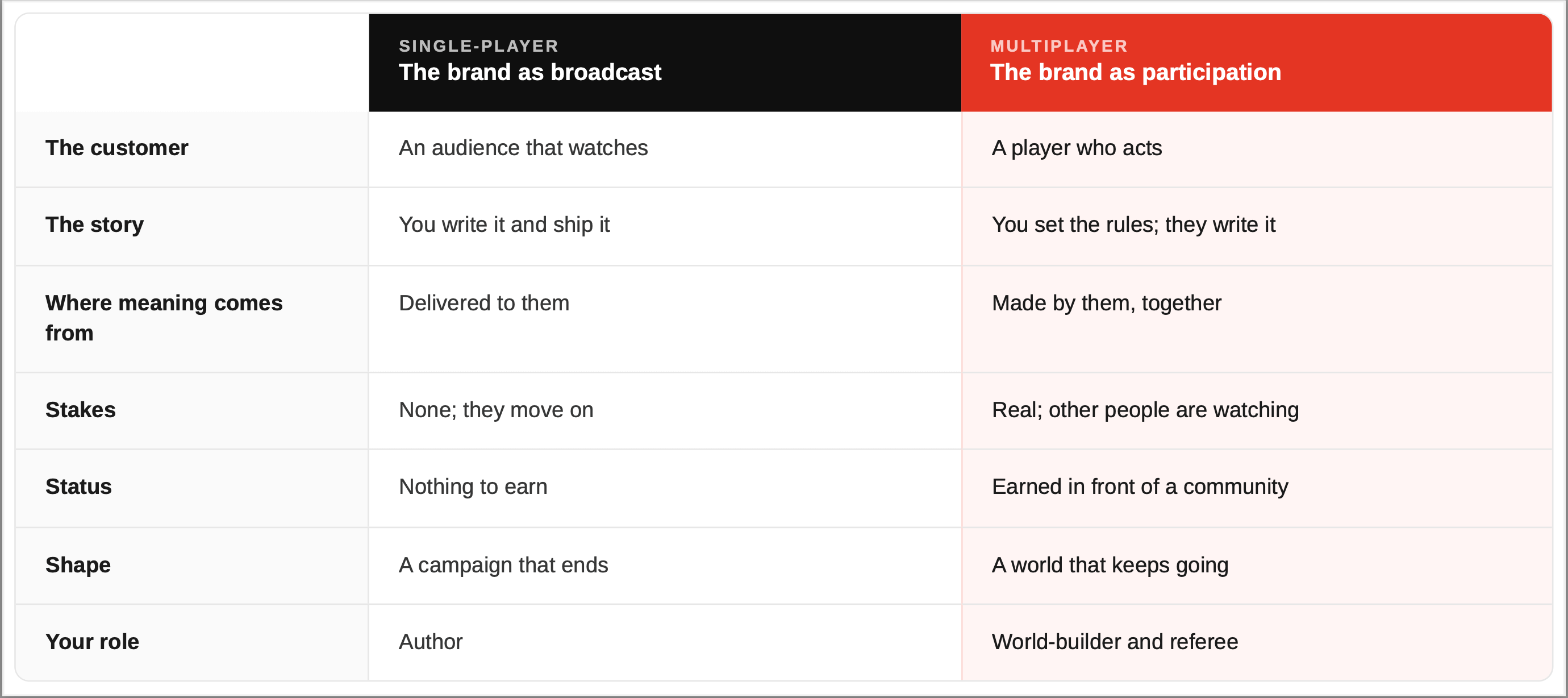
A participatory brand is a multiplayer game. It doesn’t hand people a finished story. It builds a world with a few good rules, gives people real roles and real stakes inside it, and lets them make the meaning themselves, with each other. It doesn’t launch and then end the way a campaign does. It keeps going and compounds. Here is the whole shift at a glance.
Multiplayer Already Won
If that still sounds like a nice theory, look at the scoreboard in the medium the analogy comes from. Multiplayer didn’t just get popular. It won, and it won on the numbers a CMO actually reports. A great single-player game is sold once, and then it’s finished. The big multiplayer worlds never stop earning. Grand Theft Auto V shipped in 2013, and more than a decade later, its multiplayer mode, GTA Online, is still one of its publisher’s biggest earners, with cumulative bookings estimated at around $5 billion (per Take-Two Interactive results). Fortnite built its business entirely on multiplayer modes, gives the game away for free, and still made an estimated $5.4 billion in 2018, its peak year, on the way to 650 million registered accounts (Business of Apps). Roblox barely makes any games itself. Its users make them: more than 140 million people play every day, and its top thousand creators now average $1.3 million a year each, building the thing everyone else comes for (Roblox Q4 2025 shareholder letter). The whole industry reorganized around multiplayer because that is where the durability and the money turned out to be.
Brands that made the same shift show the same pattern. LEGO was on the brink of bankruptcy in the early 2000s. A central part of how it became the largest toy company in the world was opening the brand up to its fans: letting them design sets and vote on which ones get made, with more than 2.8 million people taking part and winning designs earning their creators a share of the sales (MIT Sloan Management Review). Look at the loyalty leaders, and you see it land on the P&L. At Sephora, members of its Beauty Insider community are worth more than double the average customer, and that program now drives the large majority of the company’s sales (Sephora). Participation isn’t the soft, brand-warmth part of the plan. In the companies that commit to it, it’s the growth engine.
And it doesn’t ask you to bet the quarter. You don’t tear down the campaign machine to do this. You run a participatory layer next to it and let it compound, the same way a live game keeps earning long after its launch. A single-player brand gives you a spike you have to manufacture again every quarter. A multiplayer brand gives you an asset that grows while you sleep. The first is easier to defend in ninety days. The second is the one you’ll wish you had started three years ago.
Where It Doesn’t Work
None of this is a universal prescription, and pretending otherwise is how brands end up with an abandoned Discord server and a hashtag nobody used. A few honest limits are worth naming.
It only works if people have a reason to encounter each other around what you make. Some products are functional, bought rarely, or used alone, and there’s no natural reason for customers to meet. Insurance is not a multiplayer game. Neither is most business software.
It takes time. A participatory system compounds over years and looks weak next to a campaign in its first quarter. A brand that measures everything in ninety-day windows will kill it before it does anything.
And you have to accept outcomes you didn’t choose, because the whole point is that people act on their own. In 2016, a British research council let the public vote on the name of a new £200 million polar ship. Boaty McBoatface won in a landslide, 124,109 votes to runner-up Poppy-Mai’s 34,371. The council overruled the result and named the ship after Sir David Attenborough, and the lasting story became the broken promise, not the ship (HBS Working Knowledge). If you invite people to take part and then override them, you get the worst of both worlds. You’ve made them players and then treated them like an audience.
From Author to World-Builder
So the job changes. In a single-player brand, the marketer is an author, crafting the perfect message and pushing it out. In a multiplayer brand, the marketer is closer to a game designer, or a good referee. You set the rules, hand out the roles, keep the world fair, and then you step back and let people make things you couldn’t have scripted. You give up control of the story. What you get back is people who are attached to your brand because they helped build it, and attached to each other because of it.
A stray line of code once turned a fantasy game into a plague that people still talk about two decades later, and that scientists studied like a real one. It lasted because someone had built a world where something like that could happen, not because anyone wrote it. That is the opportunity in front of every brand now. Stop writing the story. Build the place where your customers write it themselves.
Sources
Corrupted Blood incident, World of Warcraft, September–October 2005 — outbreak mechanics, spread, duration, and the studio’s server reset: https://en.wikipedia.org/wiki/Corrupted_Blood_incident
Lofgren, Eric T.; Fefferman, Nina H. “The untapped potential of virtual game worlds to shed light on real world epidemics.” Lancet Infectious Diseases 7(9), 2007: https://pubmed.ncbi.nlm.nih.gov/17714675/
Journey (2012, thatgamecompany), on its deliberately minimal multiplayer design: https://www.gamesindustry.biz/ten-years-later-jenova-chen-reflects-on-journey
Hunicke, Robin, on designing from the feeling first: https://www.gamesindustry.biz/journey-producer-start-with-feelings-not-mechanics
Reddit r/place 2017 and 2022 participation figures: https://www.adweek.com/media/reddits-r-place-april-fools-stunt-was-the-place-to-be/
Grand Theft Auto V and GTA Online among Take-Two’s leading net-bookings contributors more than a decade after launch (Take-Two Interactive FY2025 results); ~$5B cumulative GTA Online bookings is an industry estimate compiled from Take-Two disclosures: https://www.take2games.com/ir/news/take-two-interactive-software-inc-reports-results-fourth-1
Fortnite revenue and player figures ($5.4B in 2018, its peak year; 650M registered accounts by 2023): https://www.businessofapps.com/data/fortnite-statistics/
Roblox daily active users (144M, Q4 2025) and top-creator earnings, plus its user-generated model (Roblox Q4 2025 shareholder letter): https://www.sec.gov/Archives/edgar/data/1315098/000131509826000009/ex991-q42025shareholder.htm
Norton, Michael I.; Mochon, Daniel; Ariely, Dan. “The IKEA Effect: When Labor Leads to Love.” Journal of Consumer Psychology 22(3), 2012: https://www.hbs.edu/faculty/Pages/item.aspx?num=41121
McGonigal, Jane. “Gaming can make a better world,” TED2010: https://janemcgonigal.com/2014/01/06/transcript-games-can-make-a-better-world/
LEGO Ideas community scale, vote thresholds, and creator rewards: https://sloanreview.mit.edu/article/lego-takes-customers-innovations-further/
LEGO’s near-bankruptcy in the early 2000s and turnaround into the world’s largest toy company: https://businesscall.substack.com/p/legos-turnaround-from-bankruptcy
Sephora Beauty Insider community value and share of sales (figures reported by Sephora, cited in a social.plus analysis): https://www.social.plus/blog/community-members-spend-2-5x-more---why-brand-communities-drive-growth
Boaty McBoatface naming poll, 2016 — vote totals and the lesson on overriding a public vote: https://www.library.hbs.edu/working-knowledge/the-legacy-of-boaty-mcboatface-beware-of-customers-who-vote
Thanks for reading The Participation Exchange! Subscribe for free to receive new posts and support my work.