

A fan chant is barely a year old, and proof of how fast spectators become participants when a ritual is simple enough to join in a second.
Imagine you’re standing on a cold beach in Northern Europe, more than a thousand years ago. There’s fog on the water, and you can’t see far. Then you hear it. A low drumbeat, slow and steady, and under it the sound of many rowers pulling on something heavy and calling out on the beat. The sound gets louder. The fog doesn’t lift, but the rhythm keeps coming, closer and closer, until you understand what’s underneath it. Oars. A lot of them. The Vikings are almost ashore, and they want you to hear them coming.
Now, stand in a football stadium in New Jersey this summer. You’ll hear nearly the same thing.
Thousands of Norwegians are packed shoulder to shoulder in the stands, leaning back and forward in unison, pulling invisible oars through imaginary water while a drum keeps time. They chant one word, over and over. Ro. Row. From across the stadium, it looks like a single living machine, a longship made of people, hauling itself toward the final whistle.
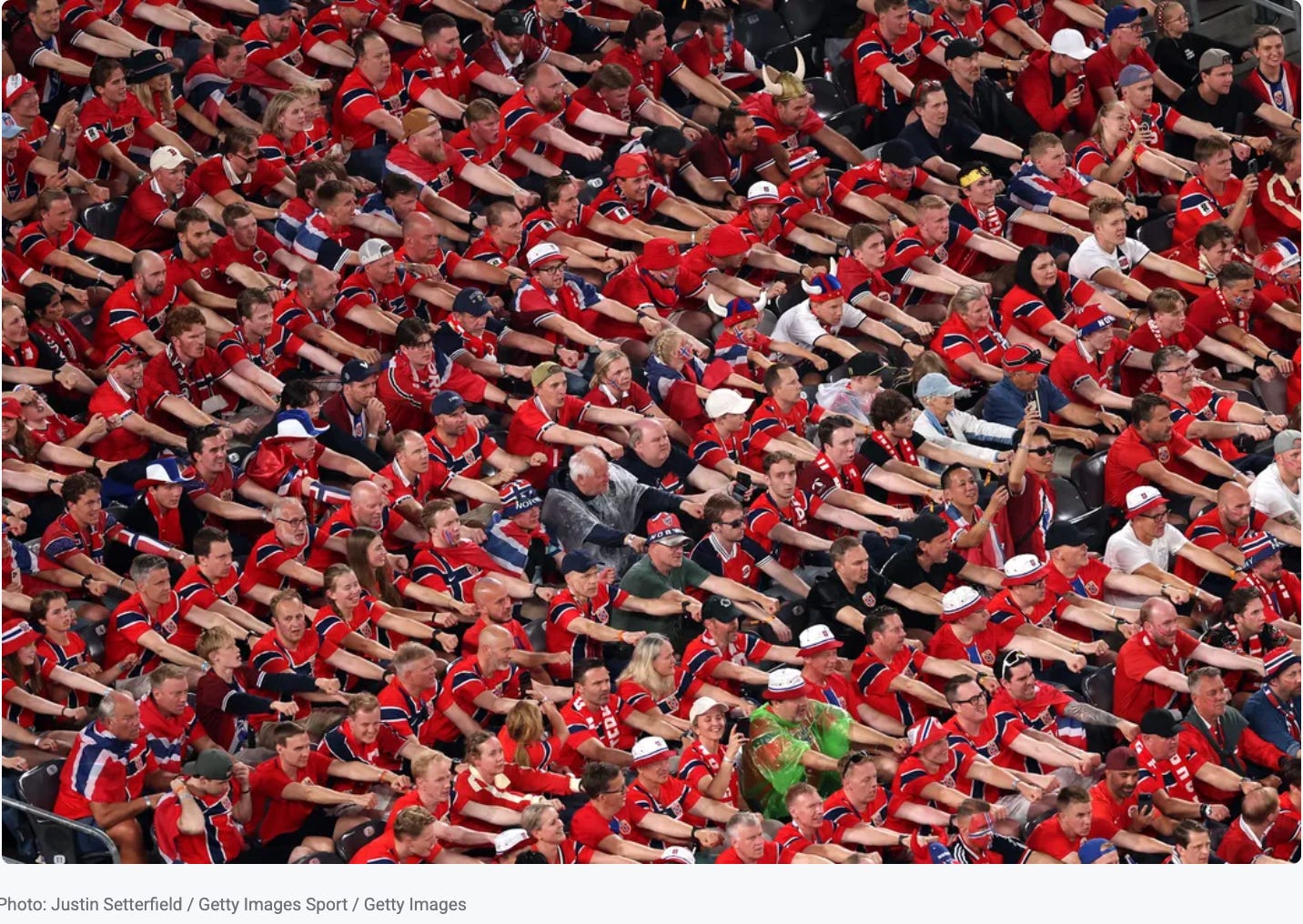
It’s called the Viking Row, and the surprising part is how new it is. This isn’t an old tradition carried down from the fjords. In its current World Cup form, it’s barely a year old.
I’ve been following Norway through this tournament partly out of bloodline, partly because the whole thing lines up with everything I’ve been writing about participation. The row is the cleanest example I’ve seen in a long time of how little a ritual needs in order to work, as long as it hands everyone an oar.
What It Actually Is
The mechanic is almost insultingly simple. You sit close to the people around you, move your arms back and forth to a drumbeat, and chant ro, the Norwegian word for row, until the sound swells into a roar. That’s the whole thing. No equipment, nothing to memorize. You sit down, take an imaginary oar, and you’re part of the crew (The Local, NPR).
It even comes with a soundtrack. The row rides on a track called Vikingblod, “Viking Blood,” which reportedly climbed to No. 1 on Spotify in Norway during the run (FourFourTwo). So the gesture has a pulse behind it, a tempo anyone can fall into on the first try.
Who Started It, And Where
Here’s the twist. This very Viking thing didn’t come down from the Viking age. It came from a guy. Ole Frøystad, a supporter from Sunnmøre and a coordinator with Oljeberget, Norway’s official supporters’ group, put it together in 2025 to give the team a distinct identity for its first World Cup since 1998 (The Local, FourFourTwo). One fan with one idea, a year before the rest of the world started copying it.
The meaning he reached for is one of Norway’s oldest and most available stories. He’s tied the row back to Viking crews taking in their sails and pulling out the oars to reach shore right before battle. A nation of 5.6 million, back on the biggest stage after 28 years in the wilderness, rowing itself into a fight. Whether that’s airtight history matters less than how instantly it reads. You get it in a second, the way you understood the fog.
There’s a split underneath all of this, and it’s the bridge to the other rituals I’ve been writing about. The athlete’s ritual is usually a private machine for control. The lucky socks, the pregame meal eaten in the same order, the breath held before a penalty kick, small spells one person casts to feel steadier inside a moment they can’t command.
The fan’s ritual runs the other way. It’s a public machine for belonging. It takes the lone spectator and folds them into something bigger and more synchronized than the self.
That’s what the row does. It doesn’t ask Norwegian fans to cheer louder or believe harder. It hands them a job. They sit, take the oar, pull in time with the people beside them, and in a few seconds, a crowd stops being a crowd and becomes a crew.
Simplicity Wins Participation
Here’s what I find genuinely instructive about it, with my strategist hat on. Most attempts to manufacture fan culture die of complexity. They need a chant with specific lyrics, or a card display, or an app, or a guy with a megaphone telling everyone what to do. The Viking Row needs none of that. It needs a body and a neighbor.
That’s the whole design lesson. A participatory ritual doesn’t scale because it’s clever. It scales because the barrier to joining is almost zero. A nine-year-old can do it. So can a grandmother who has never watched a match. A stranger two rows over is fully inside the ritual one second after deciding to try. It works at the scale of a stadium and at the scale of four friends on an escalator, which means it can be as big or as small as the moment needs it to be.
Built To Be Shared
The other reason it traveled is that it was, almost by accident, built for the feed.
Think about what a phone camera loves. Motion, rhythm, a crowd moving as one, a clean repeatable gesture, a myth you recognize on sight, a one-word name. The row has all of it. It’s multi-sensory in a way that survives compression. You see the bodies, you hear the drum, and the tempo carries even through a muted screen. It reads in three seconds, and it begs to be copied.
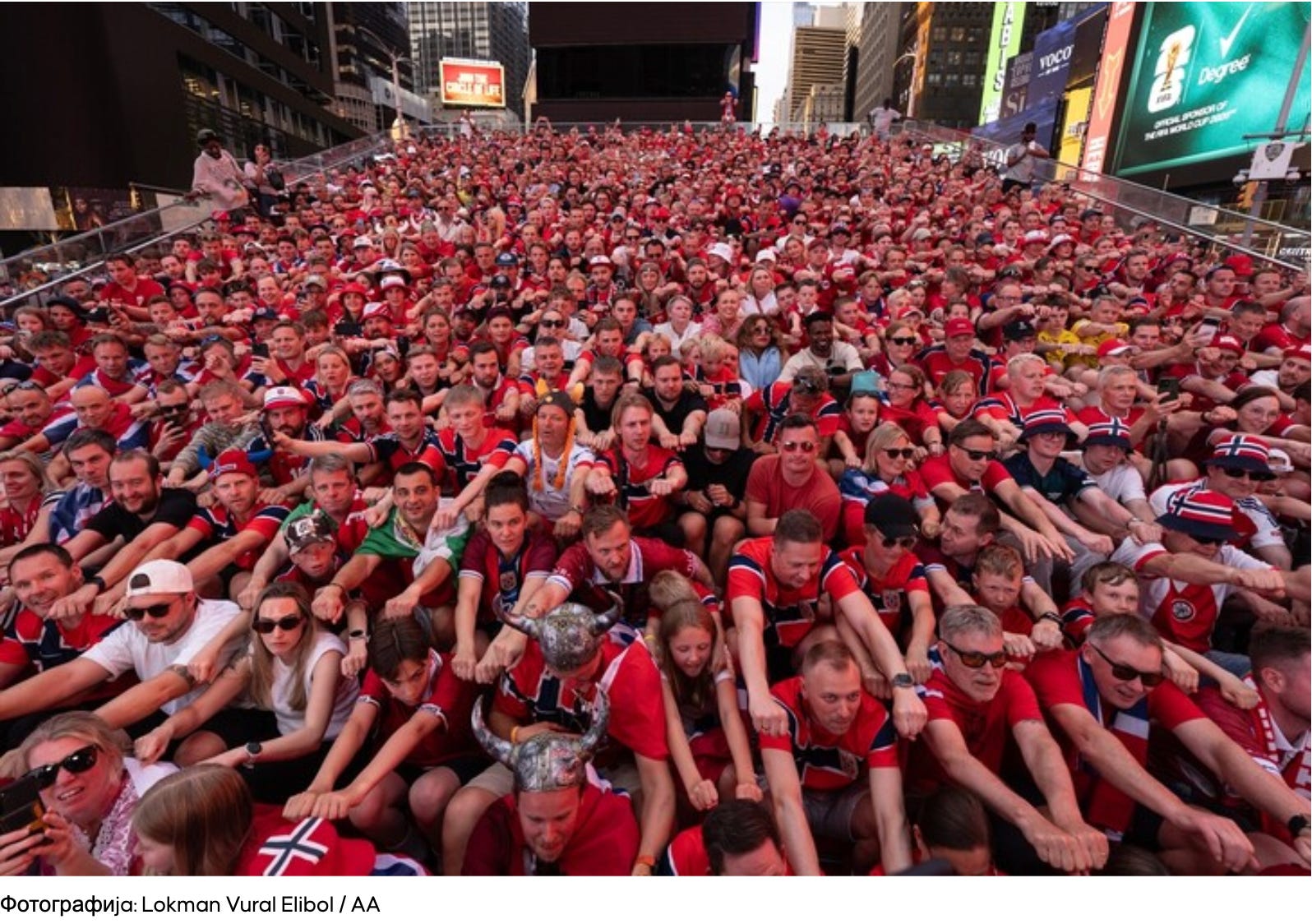
So it jumped the stadium walls. There’s a clip of Norwegian fans in Viking helmets rowing up an escalator in a Boston train station, dead serious, perfectly in time. There’s another of them filling the red steps of Times Square (NPR). Every one of those clips is an instruction manual. Watch it once, and you already know how to do it, which makes each video a recruiting poster. The ritual is the content and the call to action at the same time.
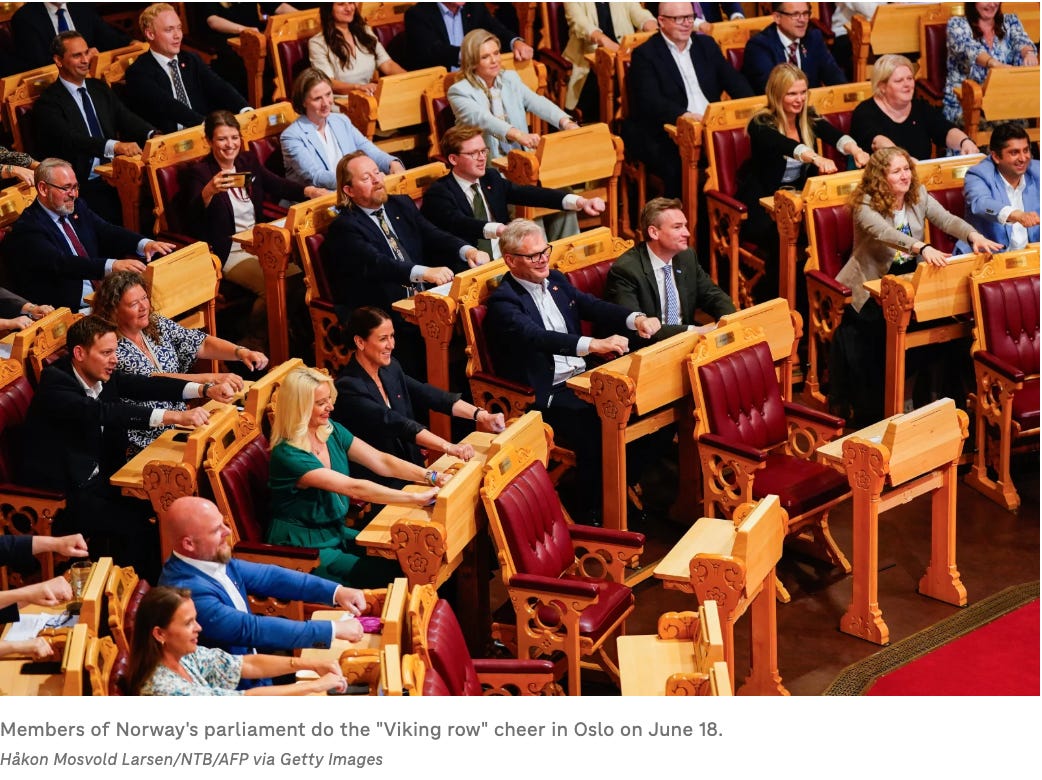
Then it climbed somewhere stranger. On the floor of Norway’s parliament, the speaker, Masud Gharahkhani, brought lawmakers to order with his gavel and led them through the row, a salute he described as coming from the heart of the country’s democracy (NPR). A fan’s idea from the year before had become a national gesture, then a global one, in a matter of weeks.
On Brand
Part of why it caught on so fast is that it never felt like an invention. It dropped into a Viking identity that Norway had already built around this team. The 2026 kit carries a typeface drawn from Elder Futhark, the old Norse runic alphabet, so Haaland’s and Ødegaard’s names run down their backs in runes (Footy Headlines). Before the tournament, the federation shot a campaign called “The Vikings Are Coming,” players in full Viking dress beside real longships.
So the symbol was already sitting there, fully loaded. The fans just picked it up and turned it into something you do with your body. That’s the line between a gimmick and a ritual that feels true. A gimmick sits on top of an identity. This one grew straight out of it.
A ritual doesn’t always earn its power by being old. Sometimes it earns it by feeling instantly remembered.
The Drum Beats Back
Then came the moment that turned a fan ritual into a shared one. After Norway beat Senegal 3-2 to reach the knockout round, the players didn’t wave and jog down the tunnel. They walked over and sat down on the grass in front of the supporters’ end. Ødegaard picked up a drum and set the beat. Haaland led the team in rowing along with the stands, the whole squad pulling imaginary oars in the dirt while the crowd pulled back (ESPN, Reuters). Haaland said afterward that Ødegaard had asked him before kickoff whether they should join in if they won. So it wasn’t a spur-of-the-moment thing. Ødegaard had imagined it before kickoff, a handshake between the pitch and the people who came to watch.
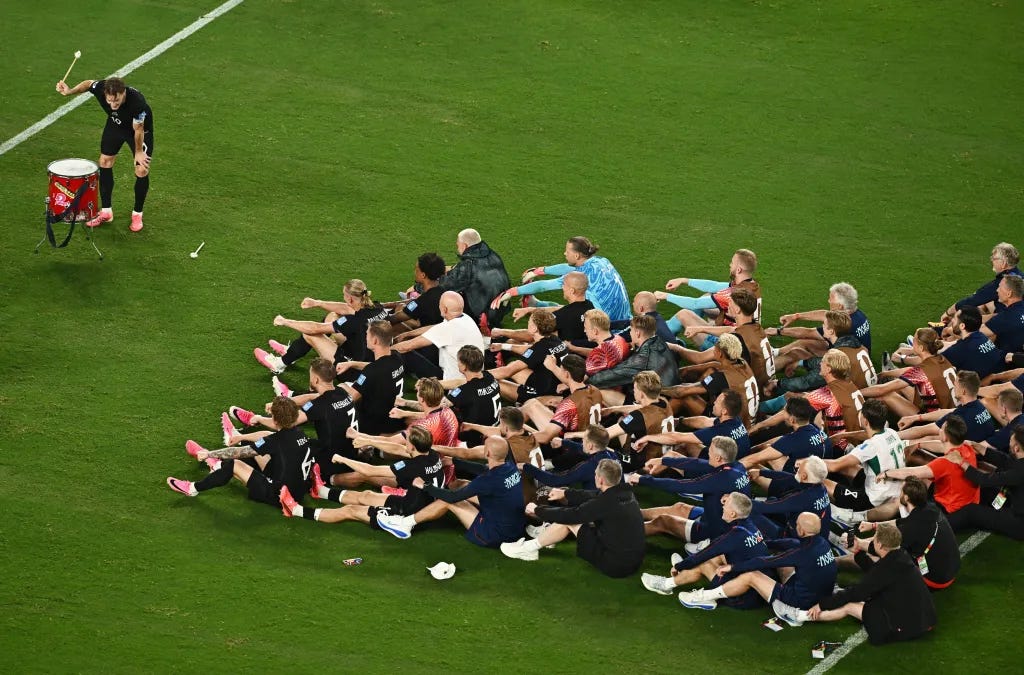
Now the ritual runs both directions. The fans row for the players. The players drum for the fans. It stopped belonging to either side, which is usually the moment a piece of culture quits being a trend and starts being a tradition.
A Way In
Strip away the runes and the drum and the chart-topping track, and here’s what’s left. The Viking Row hands everyone in the building, and everyone watching the clip, a simple physical way to stop being a spectator. That’s why it belongs in any honest conversation about participation. The rowing itself is almost beside the point.
A country waited 28 years to get back to this stage. When it finally arrived, its fans didn’t settle for wearing the flag and singing the anthem. They sat down together, grabbed imaginary oars, and built themselves a boat. For ninety minutes at a time, a scattered fanbase becomes one crew, all facing the same way, all pulling.
Go back to the fog. What made that sound on the water so frightening was the unity inside it. Every oar pulling in time. One boat, one purpose, before the keel ever touched sand. That’s what these fans have found a thousand years later, in a stadium parking lot in New Jersey. They’re not cheering from the shore. They’re rowing the boat. And the genius of it is that anyone, from any seat or any screen, can pick up an oar and climb in.
Row on, Norway.